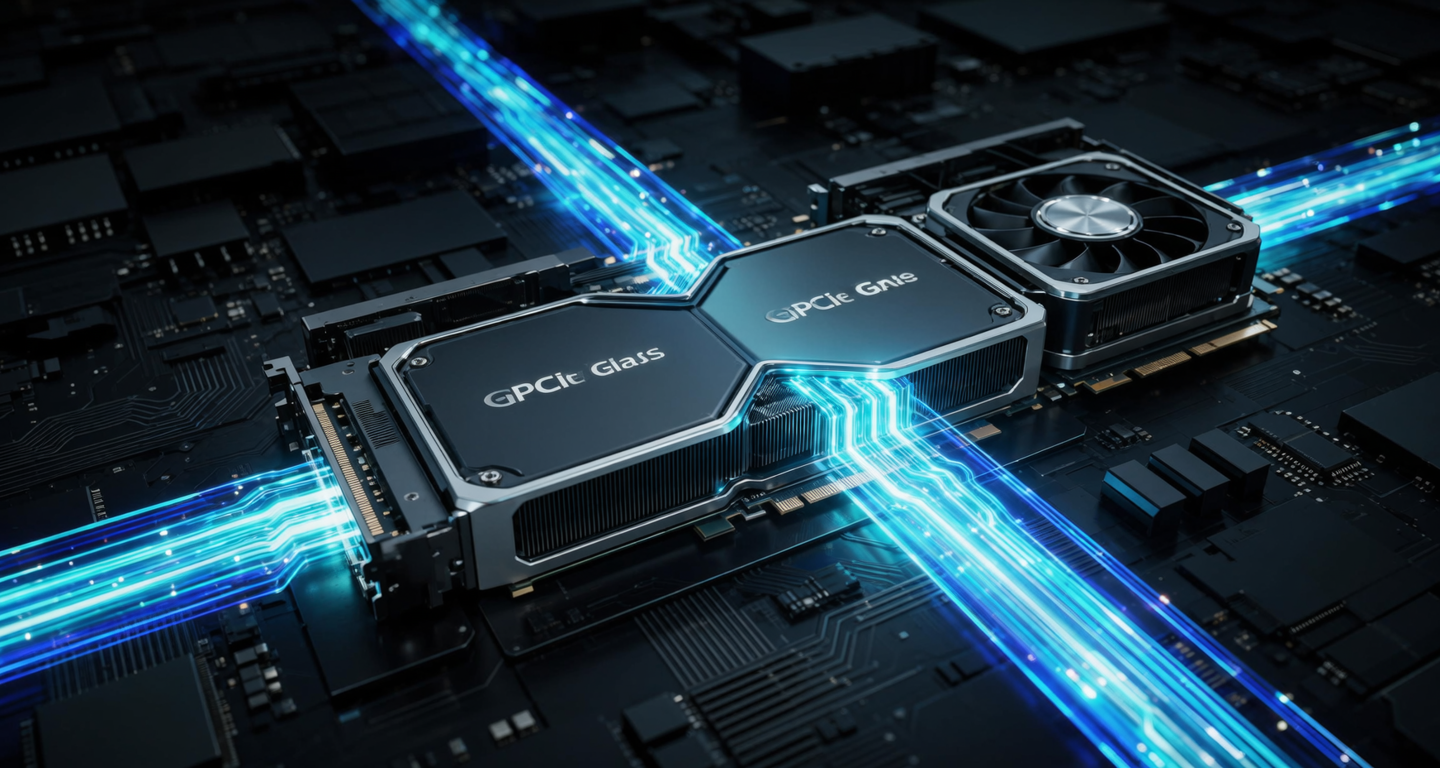
As enterprise Artificial Intelligence scales toward trillion-parameter Mixture-of-Experts (MoE) architectures, a harsh physical reality dictates data center engineering: no single GPU, regardless of its VRAM capacity, can house or train these massive models alone. The workload must be fragmented and distributed across dozens or hundreds of GPUs using techniques like Tensor Parallelism. In this distributed environment, the bottleneck completely shifts from the raw computational power (FLOPS) of the individual silicon to the speed at which these GPUs can communicate with one another. If the interconnect architecture is slow, the world's most expensive GPUs will simply sit idle, waiting for data to arrive.
The PCIe Bottleneck: The Cost of CPU-Mediated Traffic
The traditional standard for connecting hardware components in a server is the Peripheral Component Interconnect Express (PCIe). While sufficient for general-purpose computing and light AI inference, standard PCIe architecture becomes a catastrophic bottleneck for hyperscale LLM training. In a PCIe topology, GPUs cannot communicate directly. When GPU A needs to synchronize model weights with GPU B, the data must travel from the GPU, across the PCIe bus, through the server's central CPU, and back down to the second GPU.
Even with the latest PCIe Gen 5 standard, this routing mechanism caps the maximum bidirectional bandwidth at roughly 128 GB/s. During massive "all-reduce" operations—where multiple GPUs must sync their calculations simultaneously—this CPU-mediated traffic jam causes severe latency, leading to hardware starvation and plummeting compute utilization.
The NVLink Architecture: Creating a Unified Super-Accelerator
To solve this physical barrier, NVIDIA engineered NVLink, a proprietary high-speed, direct GPU-to-GPU interconnect architecture. NVLink completely bypasses the server's CPU and the traditional PCIe bus. It acts as a massive, dedicated multilane highway directly linking the VRAM of every GPU within the node.
The architectural delta is staggering: while PCIe Gen 5 struggles at 128 GB/s, the NVLink architecture on the Hopper (H100) series delivers 900 GB/s of bidirectional bandwidth per GPU, and the newer Blackwell architecture pushes this to an extreme 1.8 TB/s. Through the use of dedicated NVLink Switches, an 8-GPU server no longer operates as eight separate processors; it functions as a single, unified super-accelerator with a massive pooled memory space.
The TCO Trap: Why "Cheap" Servers Destroy ROI
From a Total Cost of Ownership (TCO) perspective, misunderstanding this architectural difference is the most expensive mistake an enterprise can make. Many organizations attempt to reduce IT expenditures by renting cheaper, PCIe-based multi-GPU servers from commodity cloud providers. However, when deployed for LLM training, these cheaper servers deliver horrific ROI.
Because the GPUs spend the majority of their time stalled by PCIe network congestion, the actual compute utilization often drops below 40%. You are essentially paying full price for high-end silicon but only extracting a fraction of its performance.
Stop Paying for Idle Compute
To achieve true linear scaling and maximum ROI on your AI investments, your infrastructure must eliminate the communication bottleneck. BRIGHTCHIP provides purpose-built, bare-metal GPU clusters featuring fully non-blocking NVLink and InfiniBand topologies. We don't just rack GPUs; we engineer the high-bandwidth physical foundations required for your engineers to train and deploy at the hyperscale level without compromising a single millisecond of latency.