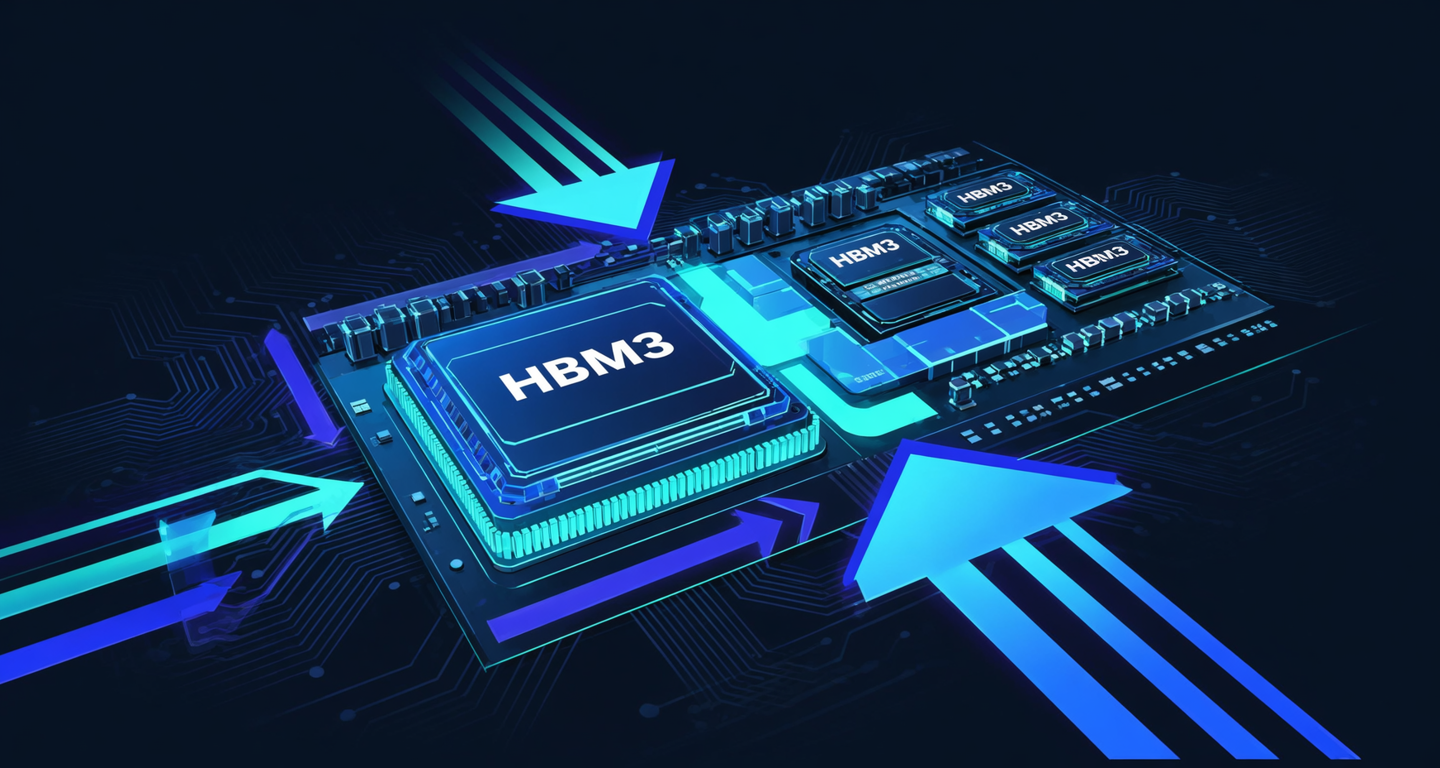
As Large Language Models (LLMs) scale beyond the 70-billion-parameter threshold, the primary bottleneck in data centers has fundamentally shifted from raw compute (FLOPS) to memory bandwidth. The previous Ampere generation, specifically the NVIDIA A100, is increasingly hitting the "memory wall." When running complex inference workloads, the A100's HBM2e memory tops out at 2.0 TB/s. Consequently, the GPU suffers from "memory starvation"—the Tensor Cores sit idle for milliseconds at a time, waiting for model weights to be loaded from memory. In enterprise deployments, this compute inefficiency severely limits inference token generation speed and drives up the operational costs per query.
The NVIDIA Hopper architecture (H100 and H200) was engineered specifically to solve this memory bottleneck. By introducing the hardware-level Transformer Engine and integrating next-generation high-bandwidth memory (HBM3 and HBM3e), the Hopper series delivers up to 6x the throughput of the A100 for large language models. Hopper is no longer just an upgrade; it is the definitive baseline architecture for modern AI infrastructure.
The H100: The Transformer Engine Advantage
The H100 introduces an architectural shift rather than a mere specification bump. Its core innovation is the dedicated Transformer Engine, a custom piece of silicon designed to accelerate the mathematical operations underlying modern LLMs.
Precision Shift (FP8): The A100 relies heavily on 16-bit math (FP16/BF16) for training. The H100's Transformer Engine analyzes tensor data in real-time and dynamically switches to 8-bit floating point (FP8) without sacrificing model accuracy. This allows the H100 to process data at double the speed of the A100's 16-bit limit.
Performance Delta: For standard LLM training tasks (such as a 175B parameter model), an H100 cluster delivers up to 9x faster training performance over an equivalent A100 cluster, reducing project timelines from several months to a matter of weeks.
The H200: Shattering the Memory Capacity Limits
While the H100 optimizes compute operations, the H200 optimizes memory capacity and speed. It is the first enterprise GPU to deploy HBM3e (High Bandwidth Memory 3 Extended).
The Capacity Leap: The H200 is equipped with 141GB of memory operating at a massive 4.8 TB/s bandwidth. This is a dramatic increase compared to the H100 SXM's 80GB at 3.35 TB/s.
The Inference Advantage: This 76% increase in memory capacity means that entire 70B+ parameter models can fit entirely onto a single GPU node without requiring complex tensor partitioning. For real-time inference workloads, the H200 generates tokens nearly 1.9x faster than the H100, drastically improving the user experience for end applications.
The Total Cost of Ownership Advantage
At the procurement level, moving from A100 to Hopper architecture changes the fundamental math of the data center. While an H100 SXM node draws more peak power (up to 700W) compared to the A100 (400W), its extreme efficiency drives down the Total Cost of Ownership (TCO). Because Hopper completes AI workloads up to 6x faster, the overall energy consumed per training run is substantially lower. Furthermore, achieving the same compute output requires significantly fewer physical servers, which eliminates the need for excess InfiniBand networking switches, reduces rack space leases, and simplifies infrastructure management. For enterprise data teams, transitioning to H100 or H200 directly translates to a lower Cost Per Token and a heavily optimized ROI on IT infrastructure spend.
Deploy Hopper Architecture Today
BRIGHTCHIP provides instant access to both H100 and H200 bare-metal GPU nodes. Eliminate the memory wall and accelerate your LLM training and inference workloads on dedicated, single-tenant infrastructure.